

A mobilisation date records a commitment. It does not, by itself, demonstrate that the committed work can be delivered. Before releasing a crew, a project needs more than a programme and an approved expenditure figure: the relevant information, permissions, materials, funding and delivery responsibilities must be available together.
This is a coordination problem, not simply a documentation problem. An approved drawing cannot compensate for unavailable access. A purchased component cannot compensate for an unresolved interface. A funded project can still lack the cash needed for its first procurement commitments.
The useful management question is therefore specific: which defined work can be released now, on what evidence, and with what remaining exposure? This article develops that question using construction-readiness research and production-control theory. The decision framework and numerical examples are Konstraff’s analytical synthesis, not a validated scoring tool or results from a measured project.
What the research actually establishes
The Construction Industry Institute’s Construction Readiness Assessment research identified 228 factors across 15 categories. Its survey covered 80 projects, classified as 41 construction-ready and 39 construction-not-ready. The researchers used the data to develop weighted assessments and readiness benchmarks. This treats readiness as a multidimensional condition rather than a single design-completion percentage. 1
That evidence should not be overstated. A survey-based assessment is not a randomised test showing that postponing any particular start will improve its outcome. Nor does the published summary establish a universal readiness threshold for every country, contract or asset type. It provides a structured basis for investigation, not a substitute for project-specific judgement.
CII’s Project Definition Rating Index, or PDRI, addresses a related but different question: the completeness of scope definition during front end planning, before detailed design and construction. Its guidance recommends repeated assessment rather than a single ceremonial review. A satisfactory scope-definition assessment should not be confused with permission to release every construction package. 2
At the production level, Ballard and Howell argue that reliable assignments depend on soundness, sequence and appropriate size. Their work focuses attention on the quality of the work released to crews and engineering teams, not merely the quantity of work started. 3
Taken together, these sources suggest three distinct levels of control: define the project, establish its execution readiness, and verify the prerequisites of the work being released.
Readiness is not an average
Suppose a work package depends on six prerequisites arriving by its planned start. In a deliberately simplified example, each has a 90% probability of being available on time. If the events are independent, the probability that all six are available is:
P(all prerequisites available) = 0.90⁶ = 0.531, or approximately 53%.
This is an illustration of joint probability, not an estimate of construction performance. Actual dependencies may be correlated, and a team’s subjective confidence rating is not a calibrated probability. The example concerns uncertain future availability; it is not a justification for proceeding before required conditions are met.
Its management implication is nevertheless important: several reassuring individual reports do not automatically establish a reliable combined start. A readiness dashboard should distinguish non-negotiable release conditions from risks that can be managed within an authorised scope. An average score must not conceal one missing condition that prevents safe or compliant execution.
Our proposed approach is to assess readiness against a defined package, location and release date. Record the evidence, its owner and its validity. A green status without those three attributes is difficult to audit and easy to misunderstand.
Design maturity should be tested at the construction interface
“Design is substantially complete” is too broad to be a release decision. For the next package, the more useful evidence is the issued information governing the actual work: requirements, dimensions, interfaces, relevant temporary works and acceptance criteria. Open items should be evaluated by their consequence for that package, not simply counted.
A foundation package, for example, may be blocked by one unresolved equipment load even when many unrelated drawings are complete. Conversely, a bounded enabling package may be executable while later architectural details remain under development. These are different exposures and should receive different decisions.
CII’s research on construction input in front end planning highlights the value of identifying material availability, labour availability and site constraints early. It distinguishes this input from a constructability review performed only after the design has already evolved. 5
A practical consequence is to involve the people who will procure, supervise, inspect and operate the work while its execution strategy can still be changed. Design, procurement and site teams should agree which assumptions are settled, which remain open, and what would invalidate the proposed release.
Connect the programme to supply and production capacity
The GAO Schedule Assessment Guide describes an integrated schedule as a model for evaluating whether intended dates are achievable. It also explains why schedule risk belongs in cost assessment: movement in delivery dates can change the resources and expenditure needed to complete the work. 4
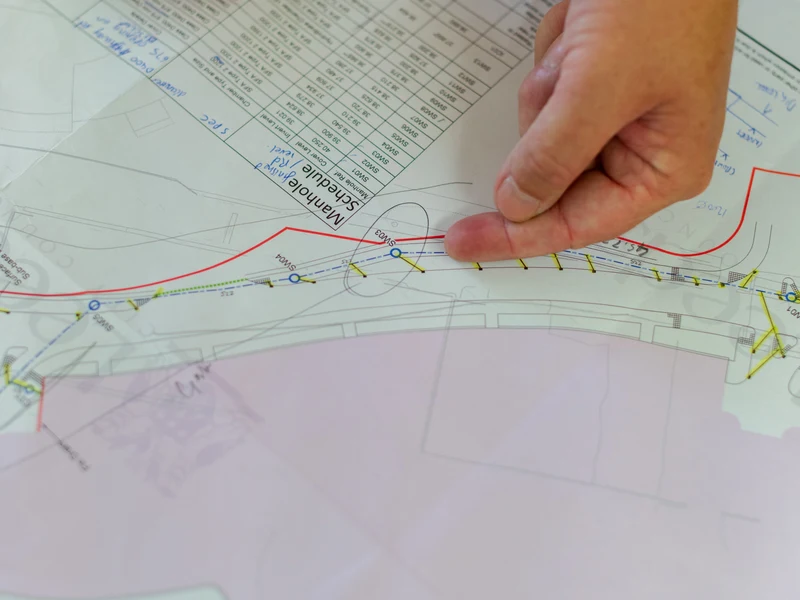
For a mobilisation review, our recommendation is to interrogate the chain behind the date. Follow the first installation package backwards through delivery, manufacture, technical approval and design information. Then check it against the people, plant, access and inspection capacity available when the work is planned.
A long-lead item is not adequately controlled because it appears on a procurement list. The team needs a credible chain of decisions and commitments, including the date at which a late approval begins to affect production. The same principle applies to information: a drawing delivered after the manufacturing decision is late even when it precedes installation.
Test alternatives before loading the site with resources. Could an independently ready package proceed? Would its early execution obstruct another trade, consume a scarce crane, or create work that must later be removed? A revised sequence is useful only when its dependencies and capacity assumptions remain credible.
This connects directly to just-in-time delivery of materials and information. Releasing work and ordering material are linked decisions, not separate departmental targets.
Separate budget adequacy from available cash
The budget review and the liquidity review answer different questions. The first asks whether the scope, estimate basis, market assumptions and risk allowances are compatible. The second asks whether the project can meet its actual payment obligations when they fall due.
Consider a hypothetical first month requiring SEK 3.0 million in supplier deposits, payroll and site establishment. If only SEK 1.8 million of cash is available before those payments, the timing gap is SEK 1.2 million. A sufficient total project budget does not remove that gap. The arithmetic says nothing about insolvency or the appropriate financing arrangement; it identifies an execution condition requiring resolution.
For this reason, we recommend checking the approved payment forecast against expected receipts, certification periods, supplier terms and any conditions attached to financing or advance payments. An advance should not be treated as available merely because someone expects it. Its approval, prerequisites and expected receipt date need to align with the commitments it is intended to support.
The release record should identify who confirms funding availability and who is authorised to commit expenditure. It should also identify the response if expected funds or receipts arrive later than planned. This is a project-control test, not a substitute for financial or contractual advice.
Authority and competence are part of the execution system
A well-populated organisation chart can still leave a critical decision without an available decision-maker. Before release, establish who can issue an instruction, accept an interface, approve a change, release an inspection hold point and resolve an urgent technical question. Confirm availability and escalation arrangements, not only names.
The same evidence-based approach applies to permissions and stakeholder conditions. A submitted application is not an issued approval. An access discussion is not necessarily an agreed possession. Identify the authorisations actually required for the proposed activity and verify their scope, conditions and timing.
For health, safety, environmental and quality controls, the release review should examine the proposed method and its prerequisites. Our recommendation is explicit: an attractive programme cannot justify bypassing required protection, competence, technical approval or inspection. Unresolved technical, commercial, financial and programme risks should also have named owners and responses appropriate to the scope being authorised.
This brings quality assurance forward into preparation. The objective is not to discover missing requirements after the work has become difficult to inspect or change.
Use a release decision, not a blanket declaration
The following is a proposed management framework. It is not a reproduction of CII’s assessment method and does not establish a contractual or regulatory approval procedure.
| Decision | Evidence needed | Control after the decision |
|---|---|---|
| Release the defined package | Required inputs, approvals, resources and funding are verified for the named scope and location. | Monitor assumptions and assess changes before continuing affected work. |
| Release a bounded early package | Its prerequisites are satisfied and it is sufficiently independent of unresolved later work. | State exclusions, interface boundaries, expenditure limits and the next review point. |
| Defer the affected package | A necessary condition is absent, uncertain or outside the authority of the reviewing team. | Assign closure actions and reassess when evidence becomes available. |
“Bounded” is the essential distinction. Conditional progress should mean permission for a specifically ready scope, not permission to proceed with unmet prerequisites inside that scope. Survey work or site establishment may be released separately only after their own access, safety, technical and authorisation requirements have been addressed.
The decision record should name the package and revision, cite its supporting evidence, record unresolved interfaces and identify the accountable release authority. Where a contractor, client, designer or external authority holds a separate approval responsibility, the internal review must not imply that it replaces that approval.
A hypothetical mobilisation decision
Imagine a project with three planned work fronts: site establishment, drainage and foundation construction. The site-establishment arrangements are verified. Drainage information is complete, but access to the outfall is unconfirmed. The foundation drawings are issued, but an equipment-load interface remains unresolved and the reinforcement order depends on an unpaid deposit.
Calling the whole project “almost ready” obscures the decision. In this hypothetical case, a bounded site-establishment release could be considered, subject to its own controls and effects on later work. Drainage would remain unreleased where the missing access prevents its execution. Foundation release would await resolution of the design interface and the procurement-funding condition.
The review should then test whether early establishment creates sufficient value to justify its cost while the other constraints are being removed. It might create useful access and facilities. Alternatively, it might simply create an expensive waiting period. The answer depends on the sequence and remaining uncertainty, not on the visibility of equipment at the gate.
The important output is a changed execution plan with named actions. It is not a favourable percentage on a mobilisation slide.
Measure the reliability of the release process
A gate review is a decision at a point in time. Design changes, delayed deliveries, access restrictions or staff availability can invalidate its assumptions. CII’s readiness research explicitly envisages repeated use of its assessment during planning and construction to help track and maintain readiness. 1
For day-to-day learning, we propose tracking three indicators: the proportion of near-term packages with verified prerequisites; the age of unresolved release constraints; and the proportion of released packages subsequently stopped because a prerequisite was missing. Define the measurement window, denominator and reason codes before interpreting trends. These are proposed diagnostic indicators, not validated universal performance benchmarks.
Review the reasons, not only the totals. Repeated interruption after release may indicate optimistic reporting, unclear package boundaries, ineffective change control or poor coordination of information and supply. The resulting action should improve the next release decision rather than simply demand more detailed reporting.
The objective is not the earliest possible mobilisation or the longest possible preparation. It is an authorised start that the project can sustain. Readiness reviews create value when they turn uncertainty into explicit decisions about scope, sequence, responsibility and resources before those decisions become costly to reverse.
References and evidence notes
The article uses the public research summaries and guidance below. The probability calculation, cash-flow example, release framework and proposed indicators are original explanatory tools, not findings attributed to these sources. The photographed people and projects are illustrative and do not endorse this article.
1. Construction Industry Institute. Construction Readiness Assessment for Productivity Improvement, RT-DCC-02. Public research summary, including the 80-project survey and assessment framework. The summary is not evidence of a randomised intervention.
2. Construction Industry Institute. Project Definition Rating Index (PDRI) Overview. Scope-definition assessment and its use during front end planning.
3. Ballard, G., and Howell, G. (1998). Shielding Production: Essential Step in Production Control. Journal of Construction Engineering and Management, 124(1), 11-17. The discussion here draws on the published abstract’s assignment-quality principles.
4. U.S. Government Accountability Office (2015). GAO Schedule Assessment Guide: Best Practices for Project Schedules, GAO-16-89G. Integrated scheduling and the relationship between schedule risk and cost assessment.
5. Construction Industry Institute (2008). Optimizing Construction Input in Front End Planning, RS241-1. Public summary and key findings on the timing and contribution of construction expertise.